
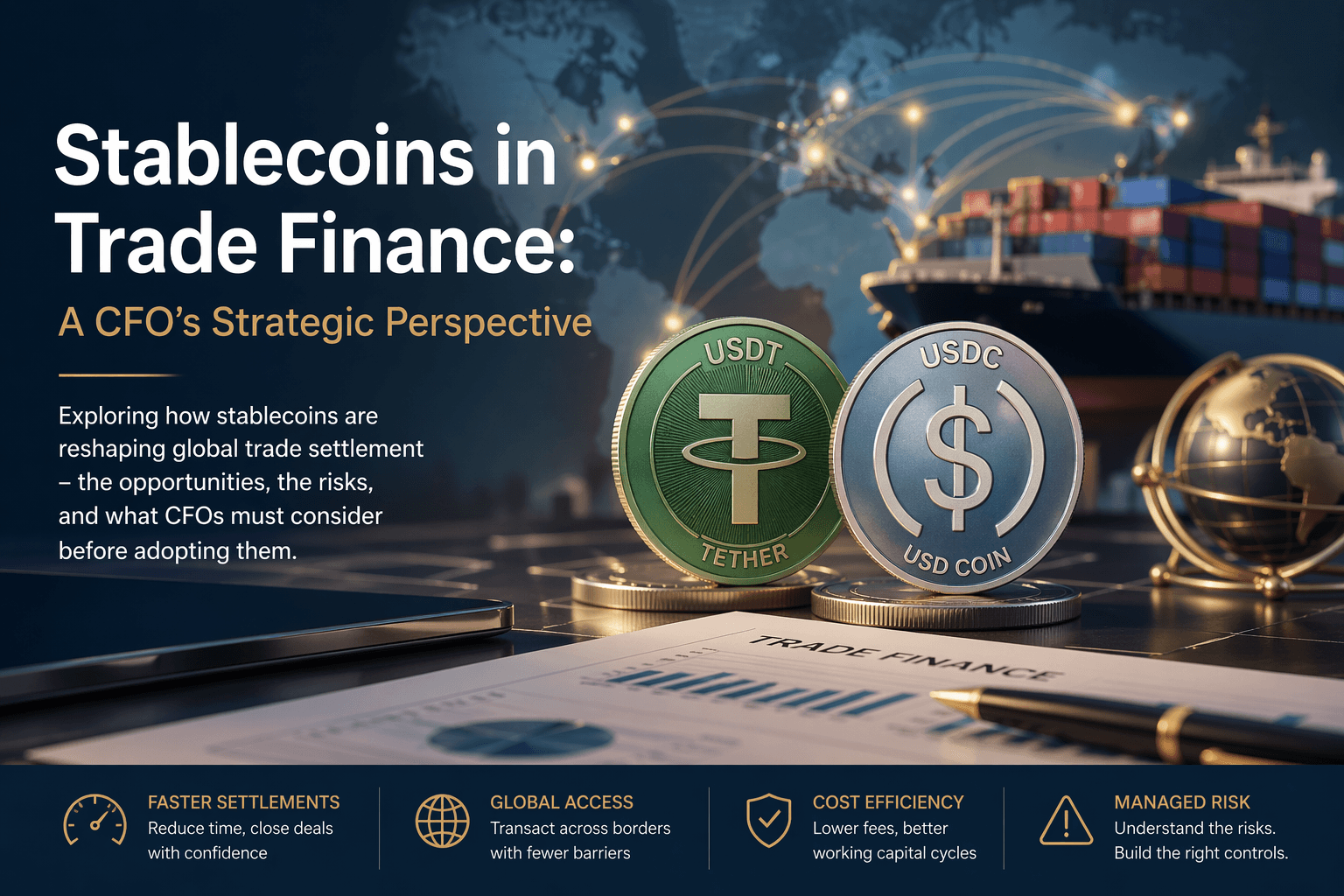
Stablecoins are transforming global trade settlement with faster, more accessible alternatives to traditional banking. For UAE CFOs, understanding their strategic integration—balancing efficiency gains with financial, operational, and regulatory risks—is crucial for disciplined risk management. Explore the benefits and challenges today.
Global trade is undergoing a structural shift in how value is transferred across borders. Traditional banking infrastructure, while robust, often introduces delays, costs, and friction, particularly in emerging markets and high-risk jurisdictions.
In this context, stablecoins such as Tether (USDT) and USD Coin (USDC) have emerged as an alternative settlement mechanism. For CFOs, the question is not whether stablecoins are “good or bad,” but rather the following:
Where do stablecoins fit within a disciplined financial and risk management framework?
What Are Stablecoins (From a CFO Lens)?
Stablecoins are digitally issued instruments designed to track the value of fiat currencies, typically the US dollar. However, unlike sovereign currency:
Stablecoins represent a private issuer’s obligation, not a central bank liability.
This distinction is fundamental. Holding a stablecoin is economically closer to holding a claim on an issuer’s reserves than holding cash in a regulated banking system.
Why Stablecoins Are Gaining Relevance in Trade
1. Speed of Settlement
Stablecoin transfers can occur within minutes, compared to traditional cross-border transfers that may take several days.
2. Reduced Dependency on Correspondent Banking
In regions where access to USD liquidity is constrained, stablecoins provide an alternative channel for value transfer.
3. Cost Efficiency
Transaction costs—particularly on certain blockchain networks—can be significantly lower than SWIFT-based transfers.
4. Accessibility in Emerging Markets
Stablecoins enable participants in underbanked regions to engage in international trade using dollar-linked instruments.
Where Stablecoins Add Strategic Value
From a CFO perspective, stablecoins can be effective in:
Trade settlement in high-friction corridors
Bridging short-term liquidity gaps
Facilitating faster working capital cycles
Reducing FX conversion layers in multi-currency trades
Key Risks That Must Be Understood—Regulatory and Compliance Risk
While operationally efficient, stablecoins introduce a different risk profile that must be actively managed.
1. Issuer Risk
Stablecoins depend on the financial strength and governance of the issuing entity. They are not backed by sovereign guarantees.
2. Liquidity and Depegging Risk
Although designed to maintain parity with fiat currency, stablecoins can temporarily deviate from their pegged value under market stress.
3. Regulatory and Compliance Risk
Regulatory treatment of digital assets continues to evolve across jurisdictions. Compliance requirements may differ based on geography and transaction structure.
4. Banking Interface Risk
Conversion of stablecoins into fiat currency ultimately requires interaction with regulated financial institutions, which may impose their own compliance and risk thresholds.
5. Operational Risk
Transactions are irreversible. Errors in wallet addresses or network selection can result in permanent loss of funds.
CFO Strategy: Where Stablecoins Fit
Stablecoins should not be viewed as a replacement for banking systems but as a complementary tool.
A disciplined approach includes:
Using stablecoins for short-duration settlement only
Maintaining clear audit trails and documentation
Limiting exposure to working capital needs
Converting to fiat promptly where appropriate
Diversifying exposure across instruments where required
Governance and Control Considerations
To integrate stablecoins into a corporate environment, organizations should establish:
Defined approval workflows
Wallet access controls and segregation of duties
Counterparty due diligence processes
Transaction-level documentation and reconciliation
Internal policies governing exposure and usage
Conclusion
Stablecoins represent a meaningful innovation in global payments infrastructure. They offer speed and flexibility, particularly in markets where traditional systems face limitations.
However:
They do not eliminate financial risk—they reallocate it.
For CFOs, the opportunity lies in leveraging stablecoins selectively and strategically while maintaining the discipline, governance, and risk awareness expected in traditional financial management.
Call to Action (CTA)
Explore How Stablecoins Can Enhance Your Trade Operations
If you are evaluating stablecoins for:
Trade settlement
Cross-border payments
Treasury optimization
Emerging market transactions
We can support you with:
End-to-end process design
Risk assessment and mitigation frameworks
Regulatory and compliance alignment
Implementation strategy tailored to your business model
Contact Us
Mahesh Thadani, ACCA , Msc
Managing Partner
Bridgewater Management Consultancies
Email: mahesh@bwmc.ae
Phone / WhatsApp: +971- 528766284
Website: mahesh@bwmc.ae
Disclaimer: This article is intended for general informational purposes only and reflects a strategic perspective on the use of stablecoins in trade and treasury operations.
It does not constitute:
Financial advice
Legal advice
Tax advice
Investment recommendation
Regulatory treatment, compliance requirements, and banking practices related to digital assets vary across jurisdictions and may change over time. Readers are advised to seek professional advice tailored to their specific circumstances before implementing any structure involving stablecoins or digital assets.
Written By

Written by
Mahesh Thadani
Director
Mahesh Thadani is a seasoned Certified Chartered Accountant and senior finance professional with extensive expertise across taxation, financial advisory, and international business structuring. With a strong command over UAE regulatory frameworks—including VAT, Corporate Tax, ESR, AML, and KYC compliance—he advises businesses on navigating complex financial and legal landscapes with precision and strategic clarity.