
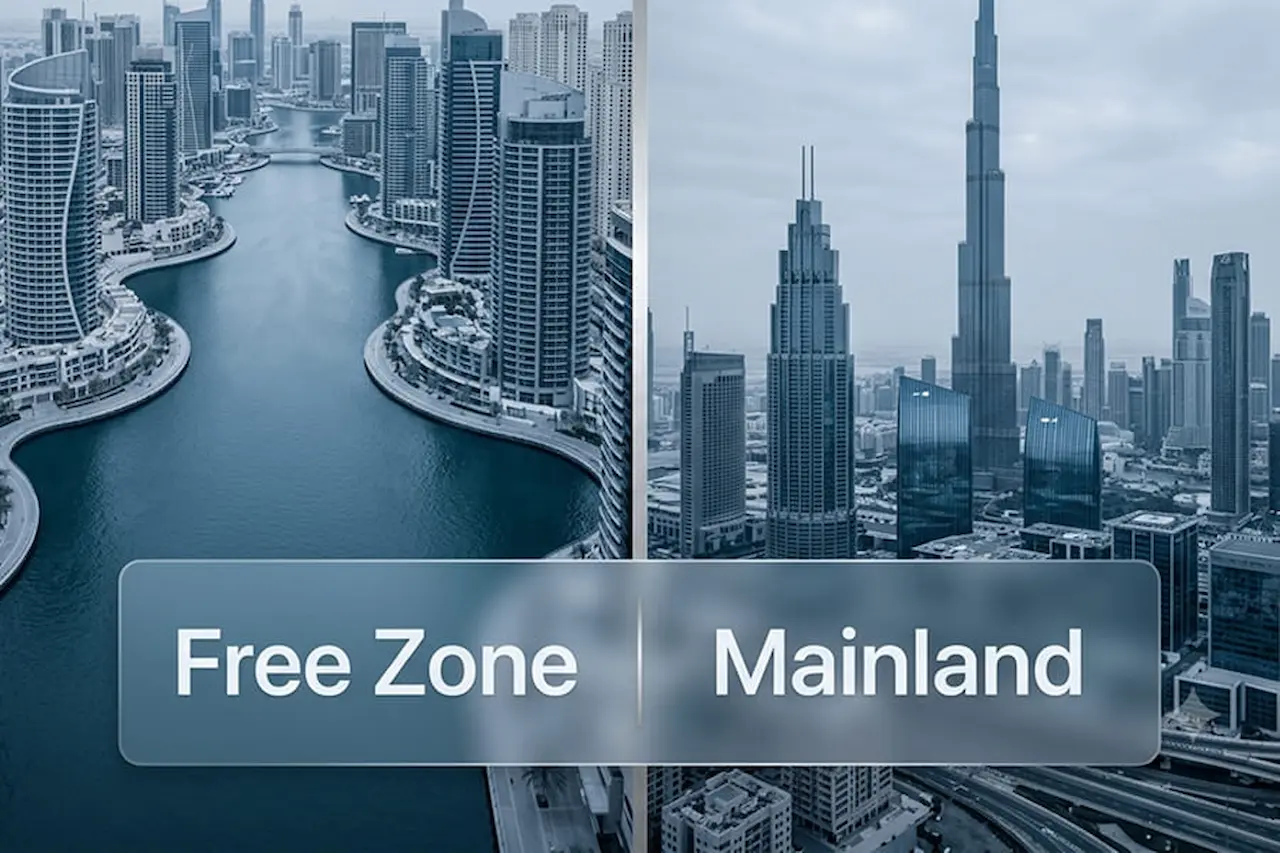
Compare UAE free zone vs mainland company tax rates for 2026. Real QFZP rules, 9% vs 0% examples, and which structure saves you more.
Free zone companies do not automatically pay 0% tax, and mainland companies do not automatically pay 9% on everything. The real answer depends on your income type, your clients, and whether you qualify as a Qualifying Free Zone Person (QFZP). Below, we break down exactly how each structure is taxed in 2026, with real numbers.
Most business owners ask this question at the wrong stage — after they've already registered. We answer it before you commit, because the structure you choose today decides your tax bill for years.
How UAE Corporate Tax Actually Works in 2026
The UAE applies one federal corporate tax law to every business, mainland or free zone. The difference is in which rate applies to which income.
Mainland companies pay 0% on the first AED 375,000 of taxable income and 9% on everything above it, with no exceptions once that threshold is crossed.
Free zone companies can pay 0% on their "Qualifying Income" — but only if they hold Qualifying Free Zone Person (QFZP) status. Any income outside that category is taxed at the standard 9%, and the AED 375,000 relief does not apply once QFZP status is in play.
This is the detail most guides skip: registering in a free zone gives you eligibility, not automatic exemption. We have reviewed client structures where a free zone company assumed it was tax-free and discovered, only at filing time, that half its revenue fell outside "Qualifying Income" and was taxed at the full 9%.
What Actually Qualifies for 0% in a Free Zone
To keep the 0% rate, a free zone entity must pass every one of these conditions, every year:
Be legally incorporated in a recognized UAE free zone
Maintain real physical presence — an office and qualified staff, not a virtual address
Earn income only from approved "Qualifying Activities" (manufacturing, fund management, holding of shares, logistics, and similar categories)
Stay under the de-minimis limit: non-qualifying revenue cannot exceed the lower of AED 5,000,000 or 5% of total revenue
Maintain audited financial statements and comply with transfer pricing rules
Breach any single condition, and the entity loses QFZP status for that period and the following four periods — taxed at 9% on all income, with a retest only after year six. This is a compliance position that is tested annually, not a one-time registration benefit.
Mainland: Simpler Rules, Full Market Access
Mainland companies trade this complexity for simplicity. Since 2021, most sectors allow 100% foreign ownership on the mainland, so you are not required to bring in a local partner the way older structures once demanded.
A mainland company pays a flat structure: 0% up to AED 375,000, 9% above it, with no activity restrictions and no de-minimis testing. You can sell directly to any customer in Dubai, Abu Dhabi, or across the Emirates without the cross-border restrictions free zone companies face when dealing with mainland clients.
Worked example: A business earning AED 1,000,000 in taxable income on the mainland pays 0% on the first AED 375,000 and 9% on the remaining AED 625,000 — a total tax bill of AED 56,250. A free zone company earning the same AED 1,000,000, but only qualifying as QFZP on AED 600,000 of it, pays 9% on the remaining AED 400,000 non-qualifying portion — AED 36,000 — even though a larger share of its income was technically "tax-free."
Small Business Relief Changes the Calculation — But Only Until December 2026
If your revenue is under AED 3,000,000, Small Business Relief lets you elect zero corporate tax for the period, regardless of profit. This applies to mainland and non-QFZP free zone businesses. It does not apply to entities holding QFZP status — you cannot claim both.
This relief closes on 31 December 2026. From 1 January 2027, every UAE-resident business falls under the standard 0%/9% regime, or the QFZP regime if eligible. Businesses still deciding between mainland and free zone should model both scenarios before this window closes, because the relief can make a mainland structure the cheaper option for smaller businesses right now, even though free zones are usually assumed to be the tax-saving choice.
So Which One Actually Saves You More?
Choose mainland if you plan to sell primarily to UAE-based clients, want simple compliance, or expect revenue under AED 3,000,000 before 31 December 2026 to use Small Business Relief.
Choose free zone if your income genuinely fits Qualifying Activities — manufacturing, fund management, holding structures, or B2B services to clients outside the UAE — and you can maintain real substance year-round.
Model both if you are between AED 1,000,000 and AED 5,000,000 in projected revenue. This is where the QFZP de-minimis rule and Small Business Relief most often produce a different result than owners expect.
We always advise clients to run the actual numbers against their real income mix before registering, because the "free zone is always tax-free" assumption is the single most expensive misunderstanding we see in UAE company formation.
If you want the exact numbers for your business, our corporate tax advisory team can model both structures side by side, or you can start with our business setup services to compare mainland and free zone options for your specific activity.
Conclusion
Neither structure is automatically cheaper — the right choice depends on your income mix, your clients, and your revenue stage. Mainland offers simplicity and full market access. Free zone offers 0% tax, but only on Qualifying Income, tested every year. Run both scenarios before you register, not after.
Why Choose BWMC
We help UAE businesses choose the right structure the first time, backed by hands-on experience filing corporate tax returns for both mainland and free zone entities.
FTA-approved tax agency with direct EmaraTax filing experience
We model your actual tax liability under both structures before you commit
Ongoing QFZP compliance monitoring, not just one-time registration support
Transparent, published pricing with no hidden advisory fees
500+ UAE businesses supported across accounting, tax, and business setup
Use our cost calculator to estimate your setup and compliance costs, or book a consultation to compare mainland and free zone tax outcomes for your business.
Frequently Asked Questions
Is a UAE free zone company automatically tax-free?
No. Only entities that qualify as a Qualifying Free Zone Person and earn Qualifying Income pay 0%. All other income is taxed at 9%.
Can I switch from free zone to mainland later?
Yes, but it typically requires a new license and legal restructuring. It's worth deciding correctly at setup rather than migrating later.
What happens if a free zone company loses QFZP status?
It is taxed at 9% on all income for that period and the following four periods, with a retest only in year six.
Does Small Business Relief apply to free zone companies?
Only if they are not claiming QFZP status. A business cannot use both Small Business Relief and QFZP in the same period.
When is the corporate tax filing deadline for 2026?
For businesses with a 31 December 2025 financial year-end, the filing and payment deadline is 30 September 2026, with no routine extensions.
Written By

Written by
Mahesh Thadani
Director
Mahesh Thadani is a seasoned Certified Chartered Accountant and senior finance professional with extensive expertise across taxation, financial advisory, and international business structuring. With a strong command over UAE regulatory frameworks—including VAT, Corporate Tax, ESR, AML, and KYC compliance—he advises businesses on navigating complex financial and legal landscapes with precision and strategic clarity.